Tuesday, February 7, 2012

Frog Scribe's Chronicle


A just-completed pyramidal sculpture.


 It was meant to have a vaguely ancient Egyptian or Mayan feel, but with no particular meaning other than conveying some sort of story or history through the circuitry glyphs. 


In the center front of the piece is a circuit from my “zoo” collection which I’ve always thought looked like a frog sitting at a table or desk.  Since no better title came to mind, the work was named for that circuit. 


The black circle near the top is a device I’ve used a few times over the years with other works.  Of course there are all kinds of possibilities for what could go inside the gold circle, including gold circuitry.  That might be appropriate for some designs, but for this piece I liked the empty blackness surrounded by the gold.


 THE FROG SCRIBE’S CHRONICLE  measures about 31” x 12” x 17”,  and will be a bit taller when I add the base which was intended.


It is meant to be viewed from the front, but I liked finishing the back of the piece with a completely different style of design even if it might not usually be seen.   


Mandolin

 A recently completed chest not yet on the website.   20" x 12" x 6".   It’s called MANDOLIN because the paired circuits on the top of the chest remind me of a stringed instrument.  These circuits were collected in the 1980's.

www.theokamecke.com 


Monday, February 6, 2012

Mud & Sticks


When I chose circuit boards as an unlikely material, it wasn’t because I had any particular attraction to technical things.  I had collected them because I was amazed at the beauty of their graphic patterns, but I’d also collected rock crystals, random splashes of aluminum from a foundry floor, curious pieces of driftwood and so on.  It was a period between documentary film projects, and I felt the compulsion to be creative.  I had no idea what I would do, nor what material I would use.  If there were interesting things that could be gathered from nature I might well have tried that, but the mud and sticks around here are boring.  There aren’t even any interesting rocks, and I would know because I’ve built some stone walls.  Besides, there were plenty of others creating interesting and often beautiful artworks from such materials, and I didn’t want to be doing what anyone else was doing.

So I started fooling around with the circuit boards that had been sitting for years in my basement, and in a few days I was hooked.  It was immediate that the material would have to be treated with some precision, whatever I would make from it.  Otherwise the sloppiness would divert attention from the graphic qualities of the circuitry, and the whole idea would be pointless.  I have no love of precision except when it’s necessary, but in this case it became central to the concept.  It’s why for instance, you can look at one of the chests and imagine having seen something like that in an art museum.  That does make it harder to do, but that’s the nature of the beast I chose.        

Time

People are always asking how long it takes to make one of my pieces.  (I’m never sure whether it’s because they are dazzled by the complexity of the circuitry, or whether they are trying to figure out how much the work should cost).  It can take a few weeks or a couple of months of solid work depending on the piece, sometimes longer.  I seldom work on a piece in one stretch from concept to completion.  Often works are partially designed or partially finished and left for months or even years until I hit on a solution that will let me continue – when I can find the time.  There are many beautiful circuits that I avoid using for other purposes simply because I have in the back of my mind the exact purpose to which those pieces of circuitry should be put, even if that work has not yet crystallized.  However it works out, I never seem to produce more than a few chests per year, for instance, and some years none at all.

Wednesday, January 18, 2012

My Zoo

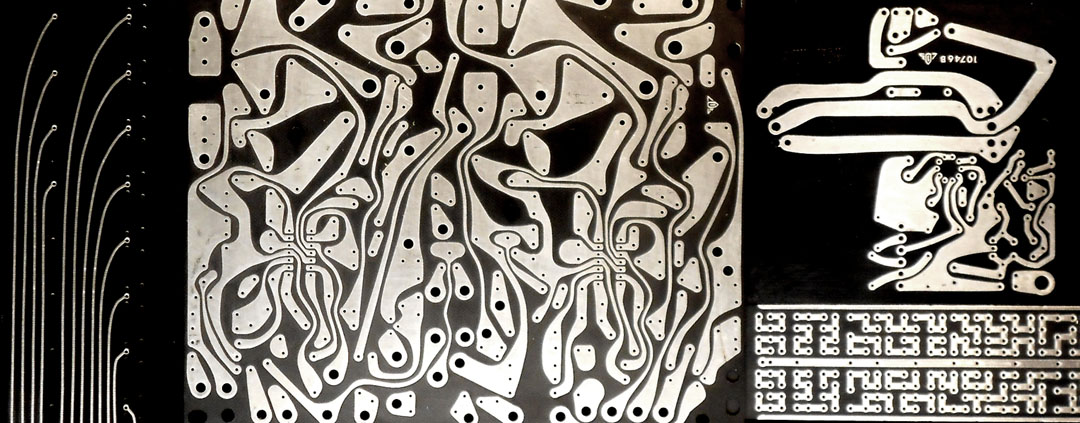
When I decided to use circuitry as my material it was obvious to me that I would have to gather as large and varied a collection as possible from dozens of factories, so I could have the flexibility to create whatever I wished.  The problem was that with thousands of pounds of circuit boards accumulating, I had to be able to easily find what was needed for each piece.  A single circuit board takes up very little space and will store on shelves like books, but like a book in a library, is impossible to find unless you know where to look. 

 If you go into a bookstore you find things arranged by topic.  I decided to arrange my circuits by aesthetic, which is the way I would use them, anyway.  It became my library of visual language.  If they had an oriental look to them, they were filed in Oriental; if the circuitry lines were serpentine they could be found in Serpentine.  Circuitry patterns that called to mind grass or flowers or trees would go in Garden.  The category Zoo is for circuits that suggest animals.  I’ve tested this on visitors, pulling out a circuit board and asking them what they see.  Often they get it right away, even though these circuits were never designed to be anything but electronic.  I have a baboon, a frog on a throne, a monkey, an elephant, a horse, a toucan, fish, Insects and so on.  A few other categories include Geometric, Candelabra, Mae West (big and curvy upstairs, slim in the waist), Formal, Mechanical, Bulbous, Maya and Chartres. These labels may not mean anything to someone else, but I almost always know where to look for something, and where to put it back.

Deciphering the Language

The design of the artworks came by instinct at first, but it became apparent that I was dealing with a visual language that seemed to have its own rules of grammar, sentence structure and form.  What was discovered by trial or instinct could prove to be one of these rules that would apply to other similar situations with the circuitry design.  How repetition or disrupted- repetition worked, or removing a visually distracting part of a circuit board.  How the eye caught the flow of lines in unexpected ways.  How density of the circuitry played into the overall flow.  How by choosing the right boldness or intricacy  of the circuitry, a piece could be made to visually work well seen at a distance and equally well but very differently when seen close.  Combining the circuitry in certain ways could provoke the feeling of eloquent prose, other ways of eccentric poetry.  It was the circuitry itself that taught me its language.

The Studio

My studio is just a football field from my back door, in a woodland clearing.  (It’s a rural area in the northern Catskill Mountains, and I have cows for neighbors).  I completely designed the studio, a builder did the basic structure to my plans, and I finished the rest.   The center of the interior is a large open space with a high arched ceiling and on both ends of the building are good-sized lofts for storage or displaying finished works.  Under the loft on one side is my workshop and all the machines, and under the loft on the other end are rows and rows of shelving for materials. On the wall of the open area opposite the main door are some tall windows, which look out on the woods.

People have occasionally asked if I get shell shock when I go into Manhattan from this quite rural place, but I lived in New York City for many years and feel quite comfortable there.  I know where all the parking places can be found, and where to not even think of looking for one.  And there are thousands of inexpensive restaurants with very good food of every kind because New Yorkers eat out most of the time.  Nothing like that in the countryside, but on the other hand I can laugh at a chickadee chasing a squirrel, or throw tomatoes at a bear who’s after the birdseed – which you don’t see very often on Fifth Avenue.  And in a little over two hours I can be on Fifth Avenue.

Saturday, December 31, 2011

About the Circuitry


When I first began creating sculptures with electronic circuitry in the mid-80’s I didn’t give much thought to the continued supply of the circuit boards I was using.  While difficult and time-consuming, it was just a matter of talking factory owners out of their overruns, rejects or obsolete stock at dozens of factories within driving distance, and when they saw what I was doing with the circuit boards, many were surprisingly cooperative.  Periodically I would make trips to choose and collect what I could use.  I was only interested in the visual quality of circuitry boards before any components were attached.  To me they were the beautiful skeletons of a new life form.  

After a few years however, I realized that things were changing and that this window on the infancy of evolving technology would soon close, and become invisible to the naked eye.  The miniaturizing of components was shrinking the circuitry patterns on the boards to which components would later be attached, and much of the circuitry pattern that was visible on the circuit boards that I liked was going to be absorbed by the invisible micro-chip components that were to be mounted on the boards.  Also, more and more of the circuit boards were being manufactured with a masking that completely covered the circuitry patterns, leaving only the contact points exposed.  The writing was on the wall. My electronic “skeletons” would soon become “fossils”.  And so up until the mid-nineties I collected as many beautiful or useful boards as I could.  Nearly all the circuit boards I use all come from the late 60’s through the mid-90’s.  That’s why I refer to them as “vintage”.  

Internally Illuminated


Among the very first works I created from circuitry were several that were internally illuminated.  The form of the sculpture was constructed from acrylic sheet, to which the pale greenish translucent circuitry panels were applied, and a lighting system was constructed for the inside of the sculpture.  I really like the way the ghostly shadow of the circuitry pattern on the reverse side of the panel combined with the sharp silhouette of the circuitry on the front.  The whole appearance of those sculptures was very impressive.  The internal lighting required the installation of a cooling fan in the base of the sculptures to draw off the heat generated by the bulbs.  There were no compact fluorescents or LEDs in the mid-80’s.  If I did it today I would use a different source of illumination, but those sculptures were far too difficult and time-consuming, and for a variety of reasons those are the only ones of that kind I’ll probably ever make. 

Monday, December 19, 2011

About River 3A wall work for the NGA

RIVER 3A, finished late 2011, was commissioned for the National Geospacial-intelligence Agency's new headquarters near Washington,D.C.   When it has been hung in it's chosen location I'll post an image.